Product Sampling in Restaurants and Cafés: How to Do It
Product sampling in restaurants and cafés instead of on the street: choose venues, design a sample with an offer, meet food rules and count new customers.
9 min readFortuners Team
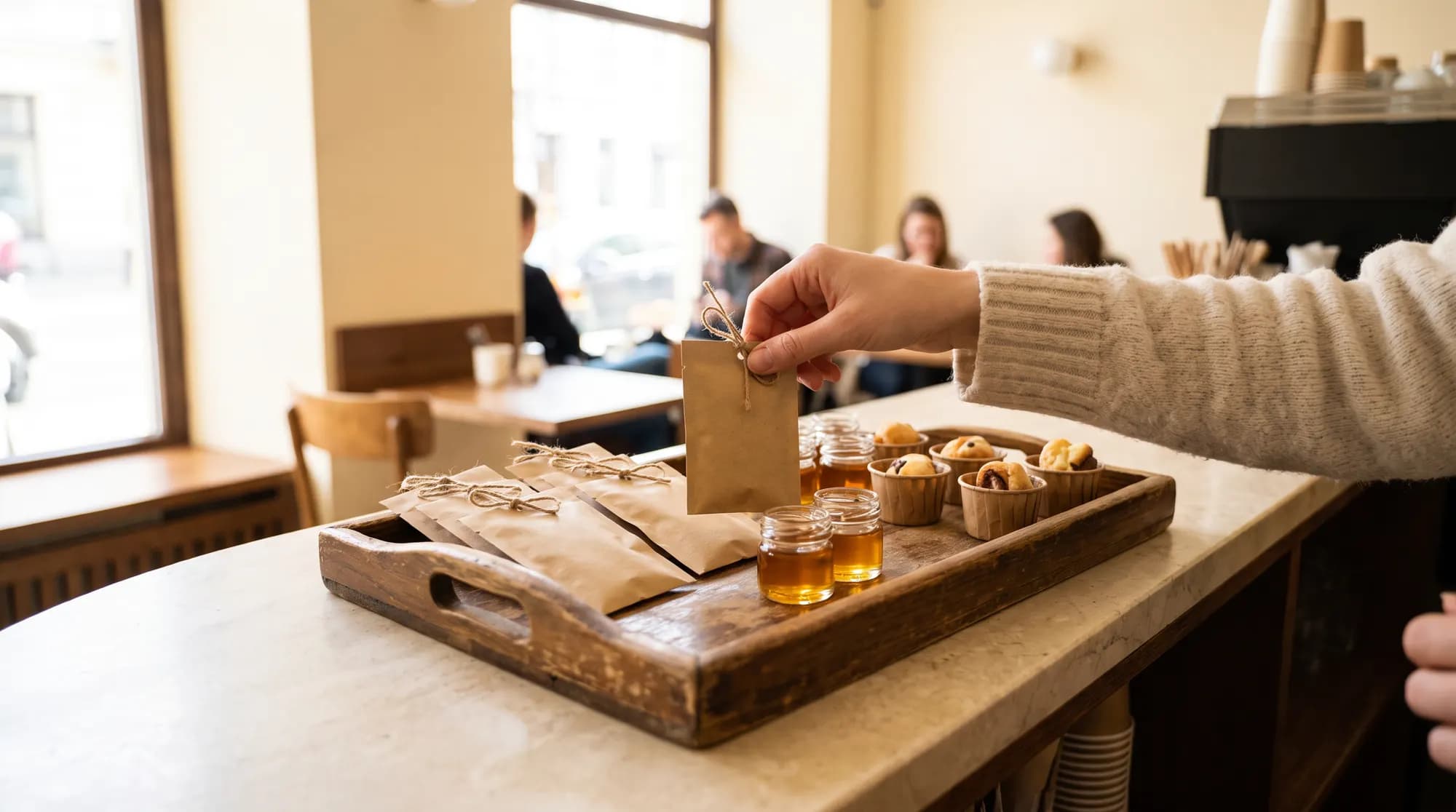
Product sampling means giving away free samples so people can try a product before they buy it. On the street, anyone who happens to walk past gets a sample, usually on the move. In a restaurant or café, you choose your audience through the venue’s profile, and the sample reaches guests when they have time to try it. This guide covers the main types of sampling, how to pick venues, a step-by-step campaign plan, the key rules for food samples, how to measure the path from sample to purchase and a ready-made four-week schedule.
What is product sampling and when does it make sense?
Product sampling is a form of promotion in which a brand gives away a small portion of its product for free to remove the barrier to a first purchase. Customers do not have to risk their money to find out whether the product suits them.
Not every product is a good fit. Before you plan a sampling campaign, answer three questions:
- Does a sample show what the product is worth? A new granola flavour or a hand cream, yes. A mattress or a language course as a “sample” is much harder.
- Is it easy to buy after trying? If the product is only stocked in a few shops on the other side of the city, the memory of the sample fades fast. You need a simple path: an online shop, a discount code, a stockist nearby.
- Will customers come back for more? Sampling pays off best for products people buy regularly. A single purchase may not cover the cost of the samples.
Product sampling marketing works particularly well when you launch a new product, enter a new city or market, and sell something customers have the wrong idea about. For an international brand entering Poland, it is also a quick way to put the product in front of people before they see it on the shelf.
Types of product sampling: street, store, event, online and venues
You can run a sampling campaign in many settings. Each one gives you a different audience and different options for measurement.
| Setting | Who gets the sample | Context | Measurement | Typical risks |
|---|---|---|---|---|
| Street, stations, outside office buildings | Anyone walking past | Rush, little attention | Hard, mostly codes | Random audience, permits for the space |
| In-store and drugstore demos | Shoppers in the category | Next to the shelf, a decision on the spot | In-store sales during the campaign | Retailer approval, cost of promo staff |
| Events, festivals, runs | Event participants | Emotion, but also crowds and sensory overload | Codes, sign-ups on site | Short window, competing brands |
| In-pack and mail drops | Customers of an online shop or partner | At home, opening a parcel at leisure | Codes, shop data | Fit with the partner’s customer profile |
| Online sample requests | People who fill in a form | At home, self-selected interest | Form data, codes | Sample hunters with no real intent to buy |
| Restaurants and cafés | Guests of selected venues | Time, relaxation, the venue’s implicit endorsement | QR and discount codes per venue | Venue approval, food rules, logistics |
Marketers also distinguish mass sampling, where everyone in a place gets a sample, from targeted sampling, where only people who meet certain criteria do. Sampling in carefully chosen venues sits much closer to the second kind.
Why restaurants and cafés work well for product sampling
A restaurant or café is an audience filter that already exists. District, cuisine, price level and time of day describe the people at the tables quite precisely. A matcha café in Warsaw’s Powiśle district attracts different guests from a traditional milk bar (bar mleczny) next to a railway station.
The second advantage is timing. Guests have time, they are not squeezing through a crowd and they do not have to turn down a promoter. A sample served by staff is part of the visit, not an interruption.
The third is context. A food product tried at the table, next to a coffee, is tasted in natural conditions rather than in a draught at the entrance to the metro.
Matching the product to the venue and the moment
A venue will only agree to sampling if the product complements its offer rather than competing with it. Coffee beans from another roaster in a specialty café are a bad idea. Dog treats in a dog-friendly café make sense.
| Product | Matching venue | Moment | Why it fits |
|---|---|---|---|
| Dog food or treats | Dog-friendly cafés | When staff bring a water bowl | A guest with a dog is exactly the target group |
| Hand cream or balm | Restaurants with longer visits | With the bill or in the bathroom | It does not compete with the menu, and the moment is calm |
| Bread or jam from a local producer | Breakfast bars without their own bakery | With breakfast, with the head chef’s approval | It complements the dish and shows the product in use |
| Breath mints | Lunch restaurants in business districts | With the bill | Guests are heading back to meetings, and it does not compete with the menu |
| An app or a service | Any venue with a matching guest profile | After the meal | Instead of a physical sample: a small treat with an offer and a code |
No product to sample? Pair a treat with an offer
Not every brand has something that can be served at a table. A pilates studio, an arthouse cinema, an app or an online fashion store cannot hand out samples in a café. What they can do is give guests a small treat that carries their offer: a free first class, a second ticket, a trial box ordered with a code.
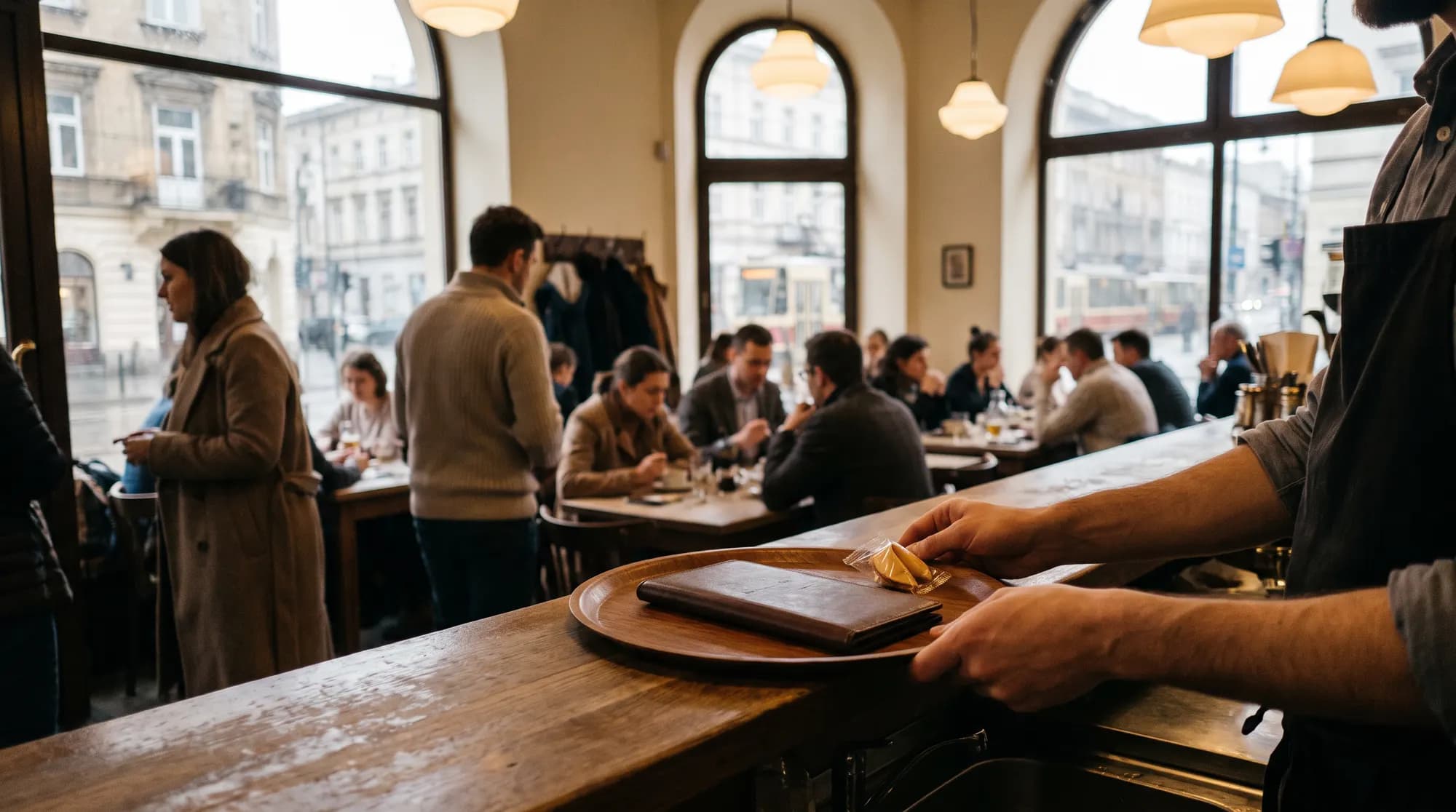
That is how Fortuners works. Guests at selected venues receive a fortune cookie with their bill, and the slip inside carries a fortune plus the brand’s offer with a QR code. The venue pays nothing for the cookies and approves every brand before launch, and the brand sees scans and redeemed codes for each venue. Here is what a message from a food brand could look like (an illustrative example):
This week you’ll discover a flavour you’ll keep coming back to.
You can read more about the format in our article on custom fortune cookies as an ad campaign, and our guide to advertising in restaurants gives the wider picture of the channel.
How to plan a sampling campaign step by step
1. Goal and primary metric
Decide what should happen after someone tries the sample. A purchase in your online shop, a newsletter sign-up with a code, a visit to a physical store. Pick one primary metric, such as the number of redeemed codes.
2. Customer profile and venue shortlist
Describe your customer in terms of places: where they live or work, where they have breakfast, where they go in the evening. Use that to build a list of venues, and score each one on guest fit, daily guest numbers and openness to a partnership.
3. The conversation with the venue
Show the owner or manager exactly what guests will receive, how it will be served and how much staff time it takes. Agree in writing on the campaign period, how samples are stored, who restocks and what happens to unused stock.
4. A sample with a call to action
A sample without an offer is a gift that leads nowhere. Attach a card or tag with one clear action:
- a one-sentence product promise,
- a single offer with an expiry date,
- a QR code that opens the offer straight on the phone,
- a discount code to enter at checkout,
- separate codes for each venue, so you can compare results.
5. How many samples you need
Illustrative example (figures made up for the calculation): a venue serves an average of 150 bills a day, and staff will realistically hand a sample to 60% of those guests. That is 90 samples a day. Over a campaign of 24 opening days, it adds up to 2,160 samples per venue. Add a buffer for damage and busier days, and split deliveries into a launch drop and weekly restocks.
6. Logistics and staff briefing
Set delivery dates, a storage spot and a simple way to report shortages. Give staff one line to say when serving the sample, for example: “With your bill today, we have a free sample of a new granola from a local producer.” In Polish venues, write that line in Polish first, and add an English version for places with many international guests. The less work it creates for the team, the more likely it is that samples actually reach guests.
Food samples, allergens and permissions
Food samples are still food, so the same rules apply as for products on the shelf. EU food law treats handing food to consumers free of charge as placing it on the market. The overview below is general; check the details for your specific product with a lawyer or food technologist.
- Labelling. Prepacked food must be labelled in line with Regulation (EU) No 1169/2011 (opens in a new tab) on the provision of food information to consumers, including an ingredients list with allergens emphasised and a best-before or use-by date.
- Polish-language information. In Poland, mandatory food information has to be given in Polish. If you bring samples in from abroad, a Polish label or sticker is part of the job, not an optional extra.
- Individual packaging. Individually wrapped samples are safer, easier to store and do not require venue staff to portion anything.
- Storage conditions. If the product needs refrigeration, check that the venue has room for it. Products with a long shelf life are far simpler logistically.
- Restricted categories. Handing out alcoholic drinks and promoting tobacco and nicotine products, medicines or food supplements with health claims are all subject to specific rules. Always run such campaigns past a lawyer.
- Consent and data. You need the venue’s written agreement. If the QR code leads to a form, prepare a GDPR privacy notice and a separate consent for marketing messages. If the campaign includes a prize draw, check whether it counts as a promotional lottery, which in Poland requires a permit.
How to measure product sampling: from sample to purchase
It is tempting to report a sampling campaign as the number of samples handed out. But that is a cost, not a result. Measure the whole funnel, all the way to purchase.
| Stage | What you count | Where the data comes from | Example (illustrative figures) |
|---|---|---|---|
| Samples handed out | Samples that actually reached guests | Deliveries minus returns and leftover stock | 4,000 |
| QR scans | Visits to the offer page | Redirect counter or web analytics | 320 (8% of samples) |
| Redeemed codes | Purchases or sign-ups with the code | Shop or booking system | 96 (30% of scans) |
| Repeat purchases | Code customers who bought again | Customer data in your shop | 29 (30% of code customers) |
With data like this, you can work out the cost per customer: divide the campaign cost by the number of redeemed codes. To compare sampling with other channels, see our guide on how to calculate customer acquisition cost.
A few rules that improve the quality of your data:
- A separate code for each venue. Only then do you know which places are worth repeating.
- A measurement window agreed before launch. Some people will use the code a week or two after the campaign ends.
- A baseline for comparison. Sales from the period before the campaign, or from a district without it, show how much comes from sampling and how much from the season.
We describe a full measurement system for offline activity, with a control group and a report template, in our guide to offline marketing attribution.
Sample four-week sampling campaign schedule
The plan below assumes two to three weeks of preparation before launch: choosing venues, signing agreements, producing samples and coded cards, and testing the offer page on a phone.
| Week | Activities | Owner | What you measure |
|---|---|---|---|
| Week 1 | Launch delivery to venues, short staff briefing, codes go live | Brand or agency, venue managers | Whether samples are being served, first scans |
| Week 2 | First restock, a chat with staff about guest reactions | Venue contact person | Scans and codes by venue |
| Week 3 | Adjustments: more samples where results are best, tweaks to the message | Brand | Scan-to-code conversion |
| Week 4 | Final restock, end-of-offer notice on the landing page, collection of leftovers | Brand or agency | Results for the whole campaign |
| 2–4 weeks after | Close the measurement window, report, decide on a next round | Brand | Repeat purchases, cost per customer |
Sampling in venues: before launch
- A sample shows what the product is worth, and it is easy to buy afterwards.
- The venues match the target group and do not compete with the product.
- Every venue has signed off in writing and knows how to store the samples.
- Samples are individually wrapped and labelled in Polish, with allergens.
- Each sample carries one offer with an expiry date.
- Each venue has its own QR code and discount code.
- The offer page works on a phone and has a GDPR privacy notice.
- Staff know the one line to say when serving a sample.
- The measurement window and report format are agreed before launch.
If your product cannot be served at a table, or you want to pair a treat with a measurable offer, see how a fortune cookie campaign works, or get in touch and tell us about your target group.
Frequently asked questions
What is product sampling?
Product sampling means giving away free samples so potential customers can try a product before they buy it. A sample removes the main barrier to a first purchase: uncertainty about whether the product will taste, smell or work the way the brand promises.
How many samples do I need for a sampling campaign in venues?
Take the number of guests or bills per day at each venue, multiply it by the share of guests staff will realistically hand a sample to, then by the number of campaign days. Add a buffer for damage and uneven traffic, and split deliveries into a launch drop and weekly restocks.
Will a restaurant agree to hand out another brand’s product?
Usually only if the product does not compete with its menu, suits its guests and adds no work for the staff. The venue needs to see what is in it for them: a nice gesture for guests, no cost and full control over what ends up on the tables.
How do you measure a product sampling campaign?
Attach a QR code and a discount code to the sample, ideally separate ones for each venue. Count samples handed out, scans, redeemed codes and repeat purchases, then compare the results with a period or area without the campaign.
Can you sample alcohol in restaurants in Poland?
Handing out and publicly promoting alcoholic drinks is subject to specific restrictions in Poland under the Act on Upbringing in Sobriety and Counteracting Alcoholism. Talk to a lawyer before you plan that kind of campaign.