Local Business Advertising: 12 Channels Compared
Local business advertising compared: 12 online and offline channels rated by local reach, entry cost and whether you can count the customers they bring.
7 min readFortuners Team

The best local business advertising is chosen by one test: can you count the customers each channel brings in? Not by what your competitors happen to be doing. This article compares 12 online and offline channels against five criteria: local reach, targeting precision, barrier to entry, measurability and time to launch. At the end you'll find a ready-made first-quarter channel mix for a local service business and three methods that show where your customers really come from.
Local advertising vs national campaigns: what's different
A national campaign builds awareness among millions of people. Advertising for a local business has a simpler and a harder job at the same time: convincing a few hundred or a few thousand people in a specific area to come in, get in touch or book an appointment.
That leads to four differences:
- The area decides everything. Someone who lives on the other side of the city is unlikely to become a regular at a tailor's or a dance school. Reaching them is wasted budget.
- Budgets are smaller, so every customer counts. There's no room for channels that "build the brand" but can't show whether they deliver anything.
- Measurement is easier than it looks. You know the customer's district, you can ask them at the till, and you can compare areas where the ads ran with areas where they didn't.
- The decision happens close to you. Customers often see the ad a few hundred metres from your door, at a moment when they have time.
We cover the wider district-level strategy in our local marketing strategy guide. Here we focus on choosing the channels.
How to compare channels: local reach, precision, barrier to entry, measurability
| Criterion | The question it answers |
|---|---|
| Local reach | How many people in your area can you realistically reach? |
| Precision | Will you reach people who might need your service, or everyone who happens to pass by? |
| Barrier to entry | Low: you can start this week, mostly with your own time or a small budget. Medium: you need design, printing or a test budget. High: a contract, a minimum order or production. |
| Measurability | Can you count customers, not just impressions or units handed out? |
| Time to launch | How long does it take from decision to first contact with your audience? |
We deliberately leave prices out. Rates depend on the city, the season and the supplier, and comparing them without the number of customers each channel brings leads to bad decisions.
12 local advertising channels in one table
| Channel | Local reach | Precision | Barrier to entry | Measurability | Time to launch |
|---|---|---|---|---|---|
| 1. Google Business Profile | medium, but people are already searching | high | low | medium | days |
| 2. Search ads with location targeting | medium | high | medium | high online, medium for visits | days |
| 3. Social media ads in a chosen area | high | medium | low or medium | medium | days |
| 4. Local groups and neighbourhood news sites | medium | high geographically | low | low without a code, medium with one | immediate |
| 5. Flyers handed out in person | medium | medium | low | medium with a code | 1–2 weeks |
| 6. Letterbox leaflet drops | high within the area | low | low or medium | medium with a code | 1–2 weeks |
| 7. Posters on notice boards and in venues with permission | medium | low | low | low | a week |
| 8. Outdoor: billboards, city lights, bus shelters | high | low | high | low | weeks |
| 9. Local press and radio | medium | low or medium | medium | low or medium | 1–3 weeks |
| 10. Shopfront, sign and A-board | low | high geographically | low or medium | low | days |
| 11. Materials at partner businesses | low or medium | high with good partner choice | low | high with a code per partner | 1–2 weeks |
| 12. Ads handed over in restaurants and cafés | medium | high | medium | high | weeks |
These ratings are indicative and describe typical use of each channel. The same channel can perform better or worse depending on the industry and the execution.
Online channels: Google Business Profile, geo-targeted ads, local groups
Google Business Profile is where people land when they search for "tailor Ochota" or "dance school near me". Fill in your categories, opening hours, services and photos, and reply to reviews regularly. Your profile's performance data shows views, direction requests and website clicks, among other things. Tag the website link with UTM parameters so that your analytics can separate profile traffic from the rest of your search results.
Search ads with location targeting reach people who are looking for your service right now. In the Google Ads location options (opens in a new tab), check the targeting setting: the default "Presence or interest" also includes people who have only shown interest in your area, while for services delivered in person, "Presence" (people in or regularly in your locations) is usually the better choice.
Social media ads let you show an offer to residents of just a few streets, but people aren't searching for a service there, so the offer has to be specific and carry a code. Without a code you'll see reach and clicks, but not visits.
Local groups and neighbourhood news sites are free, but they have rules. In Polish cities this usually means district or housing-estate groups on Facebook and local news portals. Post as a business, make it clear you're making an offer and never pose as a happy customer. Hidden advertising and fake recommendations are unfair commercial practices.
Offline channels: flyers, posters, local press, partner businesses
Flyers handed out in person work when the place and time match the offer: a dance school outside a community arts centre when children's classes finish, a tailor's by the local market on a Saturday morning. Give every distribution point its own code.
Letterbox leaflet drops cover a lot of households in the area, but they reach everyone. Respect "no flyers" stickers and building rules, because residents' irritation rubs off on your brand.
Posters belong only where you have permission: notice boards, shops, community centres. In Poland, putting up posters or notices in a public place not intended for them, or displaying them elsewhere without the consent of whoever manages the place, is a petty offence under the Code of Petty Offences.
Outdoor advertising delivers reach, but its effect is hard to measure. If you use it, add a short, memorable URL or code and compare results with a period without the campaign.
Local press and radio have loyal audiences in their region, but they rarely let you pick a specific district. A dedicated landing page URL and a discount code people can quote are the minimum if you want to count anything.
Shopfronts and signs work every day, even though you can't measure them with a code. Before you order window graphics or a new sign, check whether your municipality has a landscape resolution (uchwała krajobrazowa) with rules on advertising on buildings. Warsaw's 2020 resolution was annulled, in July 2025 the city council started work on a new one (opens in a new tab), and on 31 July 2026 the draft was sent for statutory approvals and opinions (opens in a new tab) (both in Polish), with public consultations still to come. Check the current status before you order anything.
Partner businesses are cafés, shops or gyms whose customers match your offer. A flyer left on a counter easily gets lost among all the others. Material handed to a customer directly, for example together with the bill, is much harder to miss.
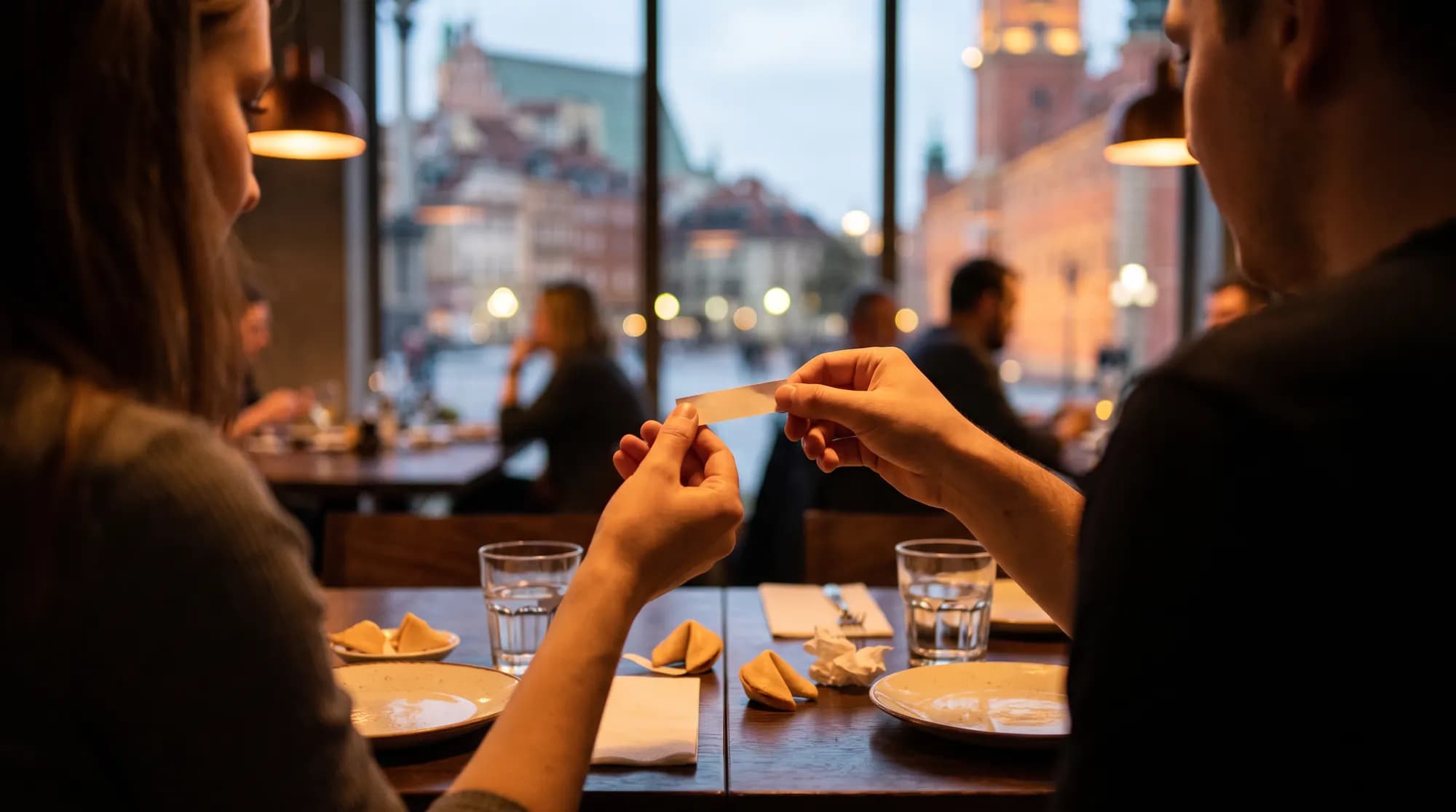
That's the idea behind Fortuners: a restaurant guest receives a fortune cookie with the bill, and the slip inside carries a brand's offer with a QR code assigned to that specific venue. The brand chooses venues its customers already visit and follows scans and redeemed codes from each location in the partner panel. Campaigns currently run in selected venues in Warsaw. You can see how this works for a pilates studio, a coworking space and a cinema in our campaign examples.
How to build a channel mix for a service business
A good mix has three layers: a foundation that is always on, two or three test channels with separate codes, and one supporting activity that keeps reminding people of your offer. After a quarter, you keep whatever brings in customers at the lowest cost.
Illustrative first-quarter plan (hypothetical business): a dance school in one district.
| Month | Activities | Measurement | Decision at month end |
|---|---|---|---|
| 1 | Complete Google Business Profile, ask for reviews after classes, UTM-tagged website link | Profile performance data, sign-ups from the website | Is the profile generating enquiries? |
| 1–2 | Test two offline channels: flyers handed out at the community arts centre and materials in three nearby cafés | A separate code for each location, a question at sign-up | Which location brings sign-ups, and which only scans? |
| 2 | Social media ads covering a few streets, with a code for a trial class | Code from the ad, sign-ups from the campaign | Does the cost per sign-up stay within your limit? |
| 3 | More budget and materials where cost per customer was lowest; switch off the weakest channel | Comparison of cost per customer across channels | Channel mix for the next quarter |
Set your limit for the cost of one customer before launch, based on how much a customer spends with you over several months and what your margin is. We explain the maths in our guide on how to calculate customer acquisition cost.
How to tell which channel brought in a customer
| Method | How to set it up | What to watch out for |
|---|---|---|
| "How did you hear about us?" question | A closed list of channels on your form and at the till, plus an "other" option | People mix up sources; staff must ask every new customer |
| A code per channel | A code whose name tells you where it came from, such as CAFES or FLYER-ARTS, with its own line at the till | Codes leak to friends and coupon sites; set an expiry date |
| A QR code per channel | A separate UTM-tagged link for each channel and location | A scan shows interest, not a customer; always compare scans with sign-ups |
No method is complete on its own, so use all three and never add the results together. A customer who used the flyer code and also ticked "flyer" in the survey is one person. For a full measurement system with control groups and a report template, read our offline marketing attribution guide.
Before you launch a local advertising channel
- You know the area where your customers live or work
- The channel carries a specific offer with an expiry date
- The channel has its own promo code or QR code
- Your staff record codes and ask where customers heard about you
- You have the property manager's permission for posters or flyers
- You know the maximum you can pay to acquire one customer
- The results review date is in your calendar
If you'd like to find out whether advertising handed to guests in restaurants suits your business and your district, get in touch. We'll tell you straight whether it makes sense in your case.
Frequently asked questions
How much does local advertising cost?
The range is huge: from activities that mostly cost time, like a Google Business Profile or partnering with neighbouring businesses, to billboards and campaigns with production costs. Rather than asking what a channel costs, work out what one customer from each channel costs. A cheap channel that brings in no customers is the most expensive one you have.
What is the best local advertising for a small business?
There's no single winner for every industry. For most local service businesses, the foundation is a Google Business Profile with reviews, plus two or three channels tested with separate codes. After a quarter, you keep the ones that bring in customers at the lowest cost.
Do flyers still work for local businesses?
They can, if they reach the right people in the right place and carry a specific offer with a code. Without a code, you'll never know whether they work. Flyers tucked under windscreen wipers and posters put up without the property manager's consent, on the other hand, carry the risk of a petty-offence fine in Poland.
How can I tell where a local customer came from?
Combine three methods: a separate promo code or QR code for each channel, a “How did you hear about us?” question with a closed list of answers, and recording the customer's district or postcode. Each method has gaps, but together they give you a reliable picture.